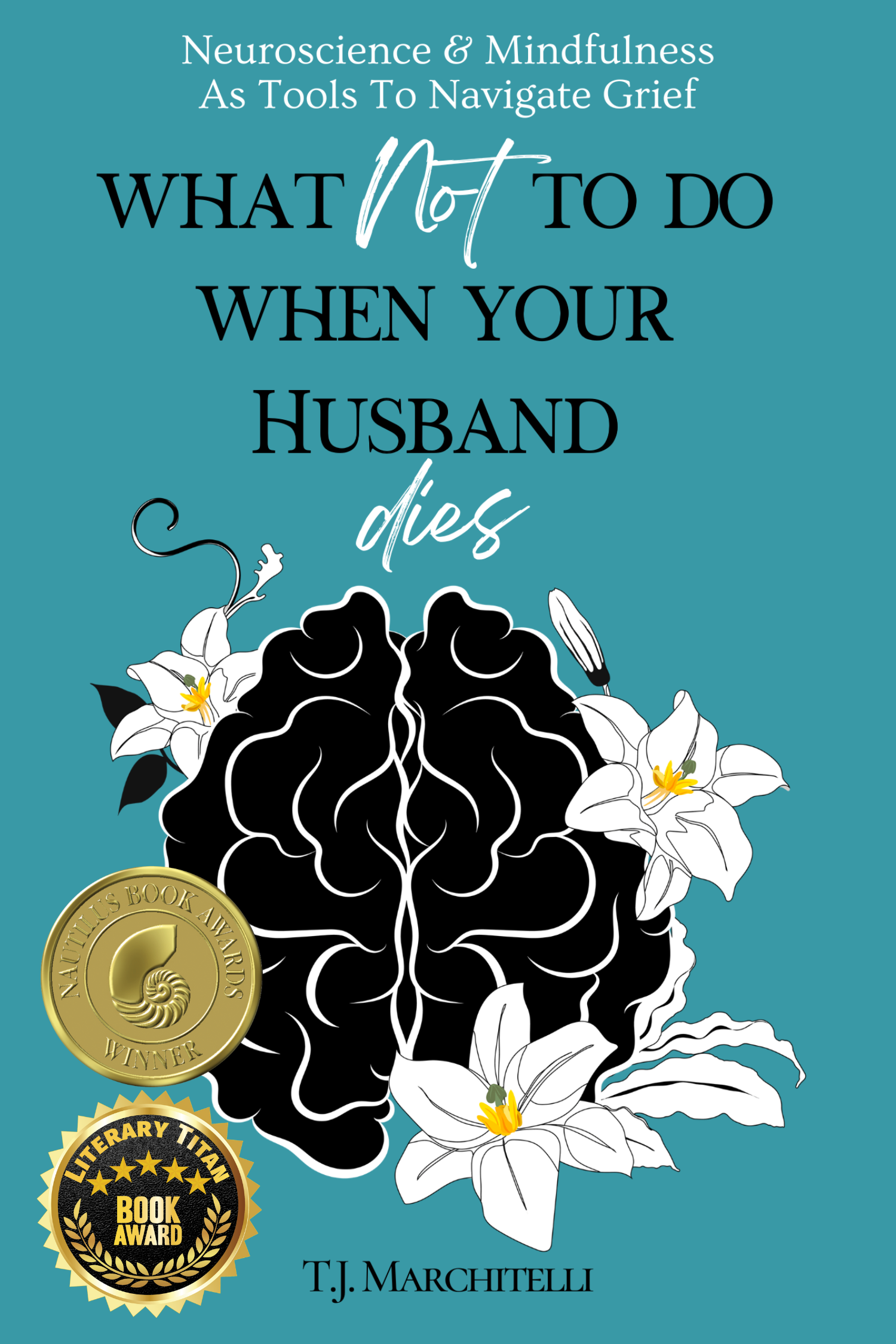
What NOT To Do When Your Husband Dies: Neuroscience & Mindfulness As Tools To Navigate Grief
On September 5, 1995, Therese Marchitelli's husband, David, died without warning. He was her partner, the father of her children, a meditation teacher and instructor, a volunteer fireman, and a businessman. He was also the only child of parents who would now grieve him for the rest of their lives. Overnight, Therese became the rock for everyone around her. After a few weeks, her support from friends and family faded, as it always does. People went back to their lives and she was left alone to sort out the rest.
She had twenty years of Buddhist meditation practice behind her, was herself a teacher and instructor in that tradition, but It wasn't enough to see her through the turbulent waters of grief. In the months and years that followed, grief clouded her judgment in ways she couldn't see at the time. She made decisions that compounded her loss — a man who arrived at her most vulnerable moment and became her business partner, money she didn't protect, red flags she talked herself past.
What Not To Do When Your Husband Dies is the book she wishes someone had handed her in 1995. It's part memoir, part practical guide, written with three decades of hindsight. It's organized around five mistakes:
- Going Solo — trying to carry everything by herself
- Flight — uprooting her life and moving to Vermont
- Relationship — accommodating a man who took advantage of her grief
- Not Honoring My Intuition — talking herself past her gut’s red flags
- Financial Responsibility — keeping her own counsel
For each one, Therese tells what happened and then explains what she'd do differently.
At the center of the book is the Board of Trust-eds™. It's her method for building a deliberate circle of support across every part of life: finances, children, health, spirituality, and social connection. Support doesn't happen on its own after a loss. It takes structure, and the book shows you how to build it. You'll also find a commitment contract to help you put it in place.
What sets this book apart is the brain. Therese studied with neuroscientist Shonté Jovan Taylor, who wrote the foreword, and became a certified NeuroGrief & Loss Coach. She explains what grief does to the brain in plain language. It affects the brain stem, the emotional limbic system, and the prefrontal cortex, where we make decisions. That's why grieving people struggle with clarity, judgment, and trust. Understanding this changes everything. Instead of stages or timelines, you get options.
The book moves through three parts: Ground, Path, and Finding Resilience. It closes with tools for the long view: a whole-brain life plan, a griever's guide to the Wheel of Life, financial empowerment, and mindfulness practices drawn from Therese's training with Chögyam Trungpa, Rinpoche. Underneath it all is a conviction she's lived for thirty years. Grief is a lifelong process. You don't go back to who you were. You move forward, with your grief as the canvas of a new life.
The book began with a widow's story, but it's written for anyone whose life has been derailed by profound loss — a death, a divorce, a career, the life you expected — and who is tired of going it alone.
Gold Nautilus Book Award
Gold Literary Titan Book Award
Book Excellence Award
This book is especially relevant now, in a Post-Covid 19 World. How many of us have consciously grieved the losses of this collective wounding? Many of the book's strategies for healing "the brain on grief" are relevant to us ALL. The beauty of this book is that it can also support ANY KIND of BIG LIFE CHANGE: the kind that shake us to our core, asking us to redefine who we are in the world and what the hell do we do now?”
— Frances Trejo-Lay, Author of Sanctuary & Planting The Seed